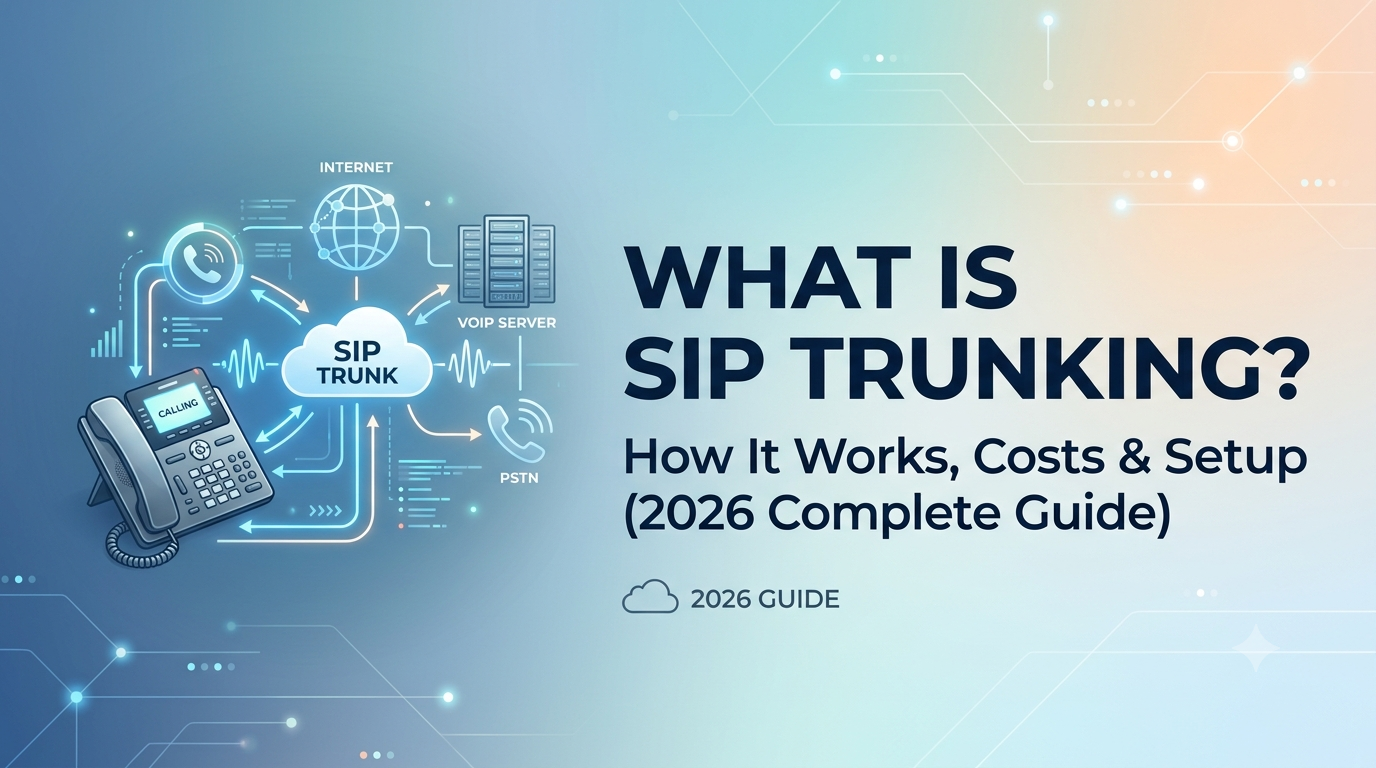
Quick answer: SIP trunking is a virtual connection that links your phone system (PBX) to the public telephone network over an internet or private IP circuit instead of physical copper lines. One SIP trunk carries many simultaneous calls, and each simultaneous call consumes one channel. Expect to pay roughly $10 to $25 per channel per month on unlimited plans, or $0.005 to $0.02 per minute metered. To deploy it you need a SIP-capable PBX, about 85 to 110 Kbps of bandwidth per concurrent call, and a provider that handles DID numbers, E911 records, and STIR/SHAKEN caller ID authentication.
Key Takeaways
- SIP trunking replaces physical phone lines, not your phone system. Your existing IP PBX stays; only the connection to the outside world changes.
- A trunk is the pipe, a channel is one live call, and a DID is a phone number. You can run 500 numbers over 20 channels because most numbers sit idle most of the time.
- SIP handles signaling; RTP carries the audio. Nearly every call quality complaint is an RTP or network problem, not a SIP problem.
- Sizing is simple math. Peak concurrent calls equal calls per hour multiplied by average call minutes, divided by 60, plus 25 to 30 percent headroom.
- Two authentication models exist: IP-based access lists for static-IP sites and digest registration for dynamic-IP sites. Choosing the wrong one causes most failed deployments.
- Compliance is not optional in the United States. STIR/SHAKEN attestation, E911 dispatchable location, Kari’s Law, and RAY BAUM’s Act all apply to SIP-delivered voice.
- SIP trunks are now the on-ramp for voice AI. Conversational agents and voicebots reach the phone network through the same trunk architecture.
Most explanations of SIP trunking stop at the definition. That is fine if you only need a glossary entry, but it is useless when you are sizing channels, arguing with a firewall, or trying to work out why calls drop exactly 32 seconds in.
This guide goes the whole distance: what SIP trunking is, how the signaling and media actually flow, how it compares to hosted VoIP and legacy PRI, what it costs in 2026 including the fees providers bury in the fine print, how to size and secure it, and how to fix the failures that show up in real deployments. If you are still at the earlier stage of picking a platform, start with our breakdown of the key factors to consider when choosing a VoIP provider, then come back here for the connectivity layer.
What Is SIP Trunking?
Definition: SIP trunking (Session Initiation Protocol trunking) is a method of delivering voice, video, and messaging sessions between a private branch exchange and the public switched telephone network over an IP network. It replaces bundles of physical telephone lines with virtual channels that can be added or removed in software.
In legacy telephony, a trunk was literally a bundle of copper pairs running from your building to the carrier’s central office. If you wanted ten simultaneous calls, you leased ten lines. If you needed an eleventh at 4 p.m. on a Friday, you waited weeks for an engineer.
SIP trunking keeps the concept and throws away the copper. The trunk becomes a logical connection between your phone system and a provider’s network, and capacity becomes a number in a portal rather than a physical install. That single change is what makes elastic scaling, multi-site consolidation, and disaster recovery rerouting possible.
What is SIP, exactly?
SIP is an application-layer signaling protocol standardized in RFC 3261. It sets up, modifies, and tears down communication sessions. It does not carry your voice.
Three protocols work together on every call:
- SIP negotiates the call: who is calling, who is being called, ringing, answer, hang-up.
- SDP (Session Description Protocol) travels inside SIP messages and describes the media: which codecs each side supports, which IP addresses and ports will carry audio.
- RTP (Real-time Transport Protocol) carries the actual audio packets, with RTCP reporting jitter, loss, and latency statistics alongside it.
A useful mental model: SIP is the air traffic controller and RTP is the aircraft. When people complain about echo, choppiness, or one-way audio, the controller is usually doing fine and the aircraft is hitting turbulence. That distinction saves hours of troubleshooting, and it is the same principle behind the network-first advice in our guide to using a VoIP system more effectively.
Trunk vs channel vs DID: the three terms buyers mix up
| Term | What it is | What you pay for |
|---|---|---|
| SIP trunk | The logical connection between your PBX and the provider | Often free or a small platform fee |
| Channel / session / concurrent call path | Capacity for one live call at a time | Per channel per month, or per minute |
| DID (Direct Inward Dial number) | A single phone number that routes to your trunk | Roughly $0.50 to $2 per number per month |
| DOD (Direct Outward Dial) | The caller ID presented on outbound calls | Usually included, subject to verification |
This is where budgets go wrong. A 200-person company does not need 200 channels. It needs enough channels to cover its busiest minute, which is typically 10 to 25 percent of headcount depending on how phone-heavy the work is.
How Does SIP Trunking Work? A Step-by-Step Call Walkthrough
Here is what happens between pressing dial and hearing a voice.
- The endpoint dials. A desk phone, softphone, or application sends the digits to your PBX.
- The PBX applies dial plan logic and normalizes the number, ideally to E.164 format such as +14155550123.
- The PBX sends a SIP INVITE to the provider’s session border controller, with an SDP body listing supported codecs and the RTP port it will listen on.
- The provider authenticates the request by matching your source IP against an access list, or by challenging with 401/407 and validating digest credentials.
- Provisional responses flow back: 100 Trying, then 180 Ringing or 183 Session Progress with early media so the caller hears ringback.
- The far end answers and returns 200 OK with its own SDP. Your PBX confirms with an ACK. The codec both sides agreed on is now locked in.
- RTP audio flows between the negotiated IP and port pairs, usually on high UDP ports in the 10000 to 20000 range.
- Either side sends BYE, the other returns 200 OK, and the provider writes a call detail record used for billing and analytics.
Signaling path vs media path
Signaling and media travel separately, and they use different ports:
- SIP signaling: UDP or TCP port 5060, or TLS on 5061 when encrypted.
- RTP media: a wide range of dynamic UDP ports, commonly 10000 to 20000, encrypted as SRTP when configured.
Two practical consequences follow. First, opening 5060 alone is never enough; if the RTP range is blocked you get calls that connect with silence. Second, encrypting signaling with TLS does nothing for the audio unless you also enable SRTP. Plenty of deployments run TLS and then send unencrypted media, which is a false sense of security.
IP authentication vs SIP registration: pick the right one
Almost every guide skips this, and it is the single most common cause of a trunk that will not come up.
| Factor | IP-based authentication | Registration-based (digest) |
|---|---|---|
| How it works | Provider whitelists your public IP address | PBX sends REGISTER with username and password |
| Requires static IP | Yes | No |
| NAT friendliness | Needs careful NAT handling | Registration keeps the NAT pinhole open |
| Failure mode | 403 Forbidden when the IP changes | Trunk drops when re-registration fails |
| Typical use | Enterprise sites, data centers, wholesale carriers | Small offices, dynamic IP, cloud PBX instances |
| Fraud exposure | Lower, tied to a network location | Higher if passwords are weak or reused |
If you have a static IP and a firewall you control, IP authentication is more stable. If your circuit hands out dynamic addresses, use registration and make sure the re-registration interval is short enough that the NAT mapping never expires, typically 60 to 300 seconds.
SIP Trunking vs VoIP vs Hosted PBX: What Is the Difference?
These three terms get used interchangeably in sales decks, and they are not the same thing. VoIP is the category. SIP is the protocol. SIP trunking and hosted PBX are two different delivery models that both use VoIP.
| Factor | SIP Trunking | Hosted PBX / UCaaS |
|---|---|---|
| Who owns the phone system | You do, on-premise or in your own cloud | The provider does |
| What you buy | Connectivity and numbers | Seats, features, and connectivity bundled |
| Pricing model | Per channel or per minute | Per user per month |
| Cost at 200 users | Flat, driven by concurrent calls | Rises linearly with headcount |
| Feature control | Total, limited only by your PBX | Whatever the vendor exposes |
| Maintenance burden | Yours: patching, backups, monitoring | Provider handles it |
| Customization and APIs | Unrestricted at the PBX layer | Vendor APIs only |
| Best fit | Existing PBX investment, contact centers, resellers, multi-site | Small teams wanting fast setup with no IT staff |
The economics flip at scale. Per-seat plans are cheap at ten users and expensive at three hundred, because you pay for every employee whether they make calls or not. SIP trunking charges for concurrency, which is a much smaller number. If you are weighing full platforms rather than connectivity, our comparison of the best unified communication solution providers covers the seat-based side of that decision, and the roundup of top VoIP companies in the USA maps who plays where.
SIP Trunk vs PRI: Why Businesses Keep Migrating
A PRI (Primary Rate Interface) is a digital ISDN circuit. In North America a T1-based PRI delivers 23 voice channels plus one signaling channel. In Europe and much of Asia, an E1-based PRI delivers 30.
| Factor | SIP Trunk | ISDN PRI |
|---|---|---|
| Capacity increments | One channel at a time | Blocks of 23 (T1) or 30 (E1) |
| Provisioning time | Hours to a few days | Two to eight weeks |
| Typical monthly cost | $10 to $25 per channel | $300 to $800 per circuit |
| Hardware needed | SIP-capable PBX, optional SBC | PRI card, channel bank, or gateway |
| Long distance and international | Substantially cheaper | Premium per-minute rates |
| Disaster recovery | Reroute numbers in a portal | Physically tied to one address |
| Multi-site consolidation | One trunk group can serve all sites | Circuit per location |
| Quality dependency | Your network and internet path | Dedicated circuit, very predictable |
| Long-term availability | Growing | Being retired as copper networks sunset |
Give PRI its due: a dedicated circuit is immune to internet congestion, which is why some hospitals, courts, and manufacturing plants held on to it. But carriers are retiring copper and TDM infrastructure, PRI pricing keeps climbing, and a SIP trunk over a dedicated MPLS or private IP path delivers the same predictability without the hardware. That combination is why migration continues at pace.
What Do You Need to Set Up SIP Trunking?
Run through this checklist before you contact a provider. Skipping items here is what turns a two-hour cutover into a two-week incident.
- A SIP-capable phone system. An IP PBX such as Asterisk, FreeSWITCH, FreePBX, 3CX, Yeastar, Avaya Aura, or Cisco CUCM. Legacy analog or digital PBX needs an FXO or PRI-to-SIP gateway in front of it.
- Sufficient internet bandwidth with headroom, ideally symmetrical. Upload is the constraint on outbound audio quality, and most business broadband is asymmetric.
- A static public IP address if you plan to use IP-based authentication.
- A router or firewall with QoS, where you can tag voice traffic as priority and open the RTP port range.
- SIP ALG disabled. This one deserves its own line. SIP Application Layer Gateway on consumer-grade routers rewrites SIP headers and breaks calls in ways that look like provider faults.
- A session border controller for anything beyond a small single-site deployment, or when you need topology hiding, transcoding, and fraud controls.
- Your DID inventory and porting paperwork: a customer service record and a letter of authorization for each number you are moving.
- E911 registration data mapping each extension or location to a dispatchable address.
- A codec decision and a documented fallback order.
How to Set Up a SIP Trunk in 8 Steps
Step 1: Audit your current call patterns
Pull 90 days of call detail records. You need peak concurrent calls, busy hour of the busy day, average call duration, and your inbound-to-outbound ratio. Buying capacity without this data means guessing.
Step 2: Test the network before you buy
Run a VoIP readiness test during your busiest hour, not a quiet afternoon. Targets: latency under 150 ms one way, jitter under 30 ms, packet loss under 1 percent. Fail any of those and fix the network first.
Step 3: Choose a provider and interconnect model
Decide between a traditional carrier trunk, a CPaaS-style elastic trunk billed per minute, or bring-your-own-carrier into a platform you already run. Weigh coverage, redundancy, porting speed, and support responsiveness rather than headline per-minute rates.
Step 4: Configure the trunk on your PBX
Enter the provider SIP server or proxy address, transport, authentication mode, and codec list. Keep the configuration minimal at first, then add features once calls work in both directions.
; Example Asterisk PJSIP trunk skeleton
[trunk-provider]
type=endpoint
transport=transport-tls
context=from-provider
disallow=all
allow=ulaw,alaw
outbound_auth=trunk-auth
aors=trunk-aor
direct_media=no
rtp_symmetric=yes
force_rport=yes
rewrite_contact=yes
dtmf_mode=rfc4733
Those last four lines solve the majority of NAT and DTMF issues before they happen.
Step 5: Open the firewall correctly
Permit SIP on 5060 or 5061 and the full RTP UDP range, restricted to your provider’s signaling and media subnets. Disable SIP ALG. Apply QoS marking so voice packets take priority over backups and file transfers.
Step 6: Test with a temporary number first
Before porting anything, prove the trunk on a test DID. Check inbound routing, outbound caller ID presentation, DTMF into an IVR, call transfer, call hold with music, fax if you still use it, and a real 911 test call coordinated with your provider.
Step 7: Port your numbers in waves
Never port your main business number on day one. Move a low-traffic department first, confirm stability for a week, then move the main lines. Keep the old circuit live in parallel until the final port completes.
Step 8: Monitor, then tune
Watch MOS, answer seizure ratio, average call duration, and channel utilization for the first month. Set alerts on channel exhaustion and on unusual international destinations. Our 7-step VoIP setup and installation guide covers the endpoint side of the same cutover, and if your team works remotely, pair the trunk with one of the best VoIP softphones for business rather than shipping desk phones everywhere.
How Many SIP Channels Do You Need?
Use the concurrency formula, then add headroom:
Peak concurrent calls = (calls in the busy hour × average call length in minutes) ÷ 60, then add 25 to 30 percent headroom and round up.
Worked example: a support desk handles 90 calls in its busiest hour with an average duration of 4 minutes. That is (90 × 4) ÷ 60 = 6 concurrent calls. Add 30 percent and round up to 8 channels. Buying 90 would waste thousands a year; buying 6 would give you busy signals during every spike.
| Business profile | Users | Suggested channels | Notes |
|---|---|---|---|
| Professional office, light phone use | 10 | 3 to 4 | Roughly a 1:3 ratio |
| Sales team, outbound heavy | 25 | 12 to 15 | Ratio approaches 1:2 |
| General business | 50 | 10 to 15 | 1:4 is typical |
| Contact center, queue driven | 50 agents | 55 to 65 | More than one path per agent for transfers and conferences |
| Multi-site enterprise | 250 | 40 to 60 | Pool centrally instead of per site |
| Predictive dialer operation | 30 agents | 90 to 120 | Dial ratio multiplies concurrency |
Two traps worth naming. Transfers and conferences temporarily consume two channels, so a busy reception desk inflates concurrency. And if you run a dialer, your channel count is driven by the dial ratio, not by agent count.
How Much Bandwidth Does SIP Trunking Need?
Codec choice determines bandwidth per call. The figures below include IP, UDP, and RTP header overhead at 20 ms packetization, which is what actually crosses your circuit.
| Codec | Payload | Real bandwidth per call, each direction | Quality | Best for |
|---|---|---|---|---|
| G.711 (u-law / a-law) | 64 Kbps | ~87 Kbps | Toll quality, no compression artifacts | Default choice, LAN and good WAN links |
| G.729 | 8 Kbps | ~31 Kbps | Good, slightly compressed | Constrained or metered links |
| G.722 (HD wideband) | 64 Kbps | ~87 Kbps | Wideband, noticeably richer | Internal and conference calls |
| Opus | Variable, 6 to 510 Kbps | ~45 to 60 Kbps typical | Excellent and adaptive | WebRTC, mobile, variable networks |
Multiply by your peak concurrency and double it for both directions. Twenty simultaneous G.711 calls need roughly 1.75 Mbps up and 1.75 Mbps down purely for voice, before any other traffic. Provision at least double that, and never plan voice capacity on a circuit whose upload is a fraction of its download.
One more practical note: G.729 saves bandwidth but consumes DSP or CPU resources for transcoding, and stacking compressed codecs across multiple hops degrades quality measurably. Prefer G.711 end to end when your circuit allows it.
How Much Does SIP Trunking Cost in 2026?
Two pricing models dominate, and the right one depends entirely on your minutes.
| Cost component | Typical 2026 range | What to watch |
|---|---|---|
| Unlimited channel plan | $10 to $25 per channel per month | Fair-use caps and per-channel minute ceilings |
| Metered domestic minutes | $0.005 to $0.02 per minute | Billing increments; per-second beats per-minute rounding |
| DID numbers | $0.50 to $2 per number per month | Toll-free costs more and bills inbound minutes |
| Toll-free inbound | $0.015 to $0.03 per minute | Marketing campaigns can spike this fast |
| E911 registration | $1 to $3 per location or DID per month | Charged per registered address, not per trunk |
| Number porting | $0 to $15 per number, one time | Expedite fees are the expensive part |
| Regulatory fees and taxes | Adds roughly 10 to 25 percent | USF, 911 surcharges, state and local telecom tax |
| SBC (hardware or virtual) | $0 to $15,000 one time, or subscription | Often required for Teams Direct Routing |
| International termination | Highly variable by destination | Mobile termination costs far more than landline |
Rule of thumb: if a channel carries more than about 1,500 to 2,000 minutes a month, unlimited wins. Below that, metered is usually cheaper. Model both against your actual call records rather than trusting the sales calculator.
The fees people forget are regulatory. A quoted $15 channel realistically lands near $18 once Universal Service Fund contributions, 911 surcharges, and state telecom taxes are applied. Ask any prospective provider for a fully loaded sample invoice, not a rate sheet. For the wider picture of what a communications stack costs beyond connectivity, our guide on how VoIP boosts efficiency for small businesses breaks down the seat-level economics, and if mobility is part of your spend, the roundup of top MVNO providers in the USA is worth a look.
Pros and Cons of SIP Trunking
Advantages
- Lower cost than legacy trunks, particularly on long distance and international traffic.
- Elastic capacity. Add channels for a seasonal spike and remove them afterwards.
- Geographic freedom. Present a New York number from a team in Manila, entirely legally.
- Built-in disaster recovery. Reroute numbers to mobiles or a backup site in minutes.
- Multi-site consolidation. One centralized trunk group can serve every branch.
- You keep your PBX and its features, protecting existing investment and customizations.
- Rich data. Call detail records and quality metrics feed analytics, CRM, and workforce tools.
Disadvantages
- Quality depends on your network. A congested or jittery circuit produces bad calls no provider can fix.
- Power and internet outages take voice down unless you build failover.
- You own the security perimeter. Toll fraud is a genuine and expensive risk.
- E911 requires deliberate configuration, because an IP address is not an address.
- It needs in-house skill, or a partner. SIP debugging is not a help-desk task.
- Fax and legacy alarm panels misbehave over compressed codecs without T.38 support.
SIP Trunk Security: Real Risks and the Controls That Stop Them
An exposed SIP port is scanned within hours of going live. Attackers are not looking for your data; they are looking for free minutes to premium-rate destinations. A single compromised trunk can generate tens of thousands of dollars in fraudulent traffic over a weekend, and most carrier contracts leave the customer liable.
| Threat | How it works | Control |
|---|---|---|
| Toll fraud | Stolen credentials used to dial premium international numbers | Country-code allow lists, spend caps, concurrency limits |
| Registration brute force | Automated guessing against port 5060 | Long random passwords, rate limiting, fail2ban, IP allow lists |
| Eavesdropping | Unencrypted RTP captured in transit | SIP over TLS plus SRTP media encryption |
| Denial of service | Flooding SIP signaling to exhaust resources | SBC rate limiting, provider-side scrubbing |
| Caller ID spoofing | Forged identity headers on outbound calls | STIR/SHAKEN signing and verification |
| Dial plan abuse | Open IVR or voicemail used to bridge outbound calls | Block call-through from IVR, disable out-dialing from voicemail |
Set a hard monetary cap with your provider as a backstop. It is the one control that limits damage even when everything else fails.
SIP Trunking Compliance in the United States
Four obligations apply to almost every business SIP deployment, and ignoring them creates both legal and deliverability problems.
- STIR/SHAKEN. The FCC required voice service providers to implement caller ID authentication in the IP portions of their networks by 30 June 2021. Calls are signed with an attestation level: A means the provider verified both the customer and their right to the number, B means the customer is known but the number is not verified, and C is gateway attestation with neither. Low attestation increasingly means your calls get labeled or blocked, so ask providers how they sign your traffic and whether they can sign your own numbers at full A.
- E911 and dispatchable location. RAY BAUM’s Act requires that a dispatchable location be transmitted with 911 calls, and it applies to non-fixed devices too. Every registered location needs a real street address plus floor or suite detail.
- Kari’s Law. Users must be able to dial 911 directly without a prefix, and the system must send a notification to a front desk or security contact when someone does.
- Robocall mitigation. Providers must file a robocall mitigation plan, and downstream carriers may refuse traffic from those who have not. If you operate as a service provider rather than an end user, this applies to you directly.
Common SIP Trunking Problems and How to Fix Them
This table is the one competing articles never publish. These are the failures that actually occur, and what causes them.
| Symptom or SIP response | Most likely cause | Fix |
|---|---|---|
| 403 Forbidden | Source IP not whitelisted, or credentials rejected | Confirm your public IP with the provider; verify the auth username, which is often not the number |
| 401 or 407 repeating | Digest authentication loop | Check realm and password; make sure the PBX responds to the challenge rather than resending the INVITE |
| 404 Not Found | Number format mismatch | Normalize to E.164 with the leading plus and country code |
| 408 Request Timeout | Signaling never reached the provider | Firewall is blocking UDP 5060; test TCP or TLS transport |
| 488 Not Acceptable Here | No shared codec in the SDP offer | Enable G.711 u-law; remove exotic codecs from the offer list |
| 503 Service Unavailable | Channel limit reached or provider trunk down | Check concurrency against your plan; confirm failover route exists |
| One-way audio | NAT traversal or blocked RTP range | Enable symmetric RTP and rewrite contact; open the full RTP port range; disable SIP ALG |
| Calls drop at roughly 32 seconds | ACK or re-INVITE lost, classic NAT or ALG symptom | Disable SIP ALG, force rport, verify the ACK reaches the provider |
| Choppy or robotic audio | Jitter and packet loss | Apply QoS, move voice off Wi-Fi, size bandwidth for peak concurrency |
| IVR does not detect key presses | DTMF sent in-band over a compressed codec | Switch to RFC 2833 or RFC 4733 out-of-band DTMF |
| Outbound calls show wrong or blocked caller ID | Unverified CLI or weak STIR/SHAKEN attestation | Register your outbound numbers with the provider; request full attestation |
| Faxes fail | Compressed codec destroying tones | Force G.711 and enable T.38, or move fax to email delivery |
SIP Trunking for AI Voice Agents and Contact Centers
This is the fastest-growing reason to care about SIP trunking in 2026. Every conversational AI agent that answers a real phone number reaches the caller through a SIP trunk. The AI is the brain; the trunk is the nervous system.
Voice AI puts unusual demands on the trunk:
- Latency budget is brutal. Natural conversation needs sub-800 ms round trip including speech recognition, model inference, and speech synthesis. Trunk routing and transcoding must not eat that budget.
- Uncompressed codecs win. G.711 gives recognition engines cleaner input than G.729. Transcoding hops add both delay and word error rate.
- Barge-in requires clean bidirectional media. Half-duplex quirks and aggressive echo cancellation break interruption handling.
- Warm transfer to humans means SIP REFER support and a channel pool sized for the overlap.
- Concurrency is unpredictable. Automated outbound campaigns can consume channels far faster than human agents.
If you are building in this direction, read our enterprise guide on how AI is transforming VoIP in 2026 for the platform layer, then compare vendors in our reviews of the best AI voicebot custom development companies in the USA and the leading AI voicebot companies for 2026. The trunk decision should come before the AI decision, because latency and codec constraints set your ceiling.
Who Should Use SIP Trunking, and Who Should Not
Strong fit
- Organizations with an existing IP PBX they do not want to abandon.
- Contact centers, where per-seat licensing becomes punishing at scale.
- Multi-site and multi-country businesses consolidating voice onto one platform.
- ITSPs, MSPs, and resellers who sell voice under their own brand.
- Regulated industries needing call recording, retention, and data residency control.
- Teams deploying voice AI that must own routing, media, and latency.
Weaker fit
- Businesses under about ten people with no PBX and no IT resource. A hosted platform is simpler and cheaper.
- Sites with unreliable internet and no realistic path to a second circuit.
- Teams that need collaboration, chat, and video bundled in one subscription with a single support number to call.
How to Choose a SIP Trunk Provider
Score candidates on these ten criteria rather than on the per-minute rate alone:
- Network redundancy. Multiple geographically separate points of presence and documented automatic failover.
- Interconnect quality. Direct carrier interconnects beat long chains of wholesale resellers, which is where audio quality quietly degrades.
- Number coverage and porting speed. Ask for realistic porting timelines in your specific rate centers.
- STIR/SHAKEN attestation. Confirm they can sign your traffic at full attestation.
- Billing granularity. Per-second billing and transparent regulatory fees.
- Fraud protection. Spend caps, anomaly alerts, and destination blocking included as standard.
- Encryption support. TLS and SRTP available without an upcharge.
- API and automation. Programmatic provisioning matters enormously if you resell.
- Real engineering support. Access to someone who can read a SIP trace at 2 a.m.
- Contract flexibility. Month-to-month options and no punitive channel minimums.
Always run a paid pilot before committing. Two weeks of live traffic reveals more than any reference call. Our VoIP research library tracks provider comparisons across UCaaS, softphones, and AI voice as the market shifts.
SIP Trunking Glossary
| Term | Meaning |
|---|---|
| SIP | Session Initiation Protocol, RFC 3261. Signaling protocol that establishes and ends sessions. |
| RTP / SRTP | Real-time Transport Protocol carries the audio. SRTP is the encrypted version. |
| SDP | Session Description Protocol. Negotiates codecs, IP addresses, and media ports. |
| SBC | Session Border Controller. Security and interworking device at the network edge. |
| PBX / IP PBX | Private Branch Exchange, the phone system that routes internal and external calls. |
| PSTN | Public Switched Telephone Network, the global circuit-switched phone network. |
| DID / DDI | Direct Inward Dial number that routes external calls to a specific destination. |
| E.164 | International number format: plus sign, country code, national number. |
| ITSP | Internet Telephony Service Provider, a company selling IP voice services. |
| MOS | Mean Opinion Score, call quality rated 1 to 5. Target 4.0 or above. |
| ASR | Answer Seizure Ratio, the percentage of call attempts that connect. |
| T.38 | Protocol for reliably sending fax over IP networks. |
| BYOC | Bring Your Own Carrier. Using your own trunks inside someone else’s platform. |
| SIP ALG | Router feature that rewrites SIP headers. Almost always should be disabled. |
Frequently Asked Questions
What is SIP trunking in simple terms?
SIP trunking is a virtual replacement for physical phone lines. It connects your phone system to the public telephone network over an internet or private IP connection, so adding call capacity becomes a software change instead of a cabling job.
What is the difference between SIP trunking and VoIP?
VoIP is the broad category of carrying voice over IP networks. SIP trunking is one specific way to deliver VoIP: it connects a PBX you control to a carrier. All SIP trunking is VoIP, but plenty of VoIP, such as hosted seats and app-to-app calling, is not SIP trunking.
How many calls can one SIP trunk handle?
As many as you provision. Capacity is set by channels, not by the trunk itself. A single trunk can be configured for 4 channels or 4,000, limited only by your bandwidth and your provider’s plan.
Do I need a PBX for SIP trunking?
Yes. A SIP trunk terminates on something that can route calls: an IP PBX, a session border controller, a softswitch, or a communications platform. Without one there is nothing for the trunk to connect to. If you have no PBX, a hosted phone system is the simpler route.
How much bandwidth do I need per SIP channel?
Around 87 Kbps in each direction for G.711 including protocol overhead, or about 31 Kbps for G.729. Multiply by peak concurrent calls and provision at least double the result so voice never competes with other traffic.
Is SIP trunking cheaper than PRI?
Usually yes, often by 40 to 60 percent, and the gap widens with international calling. A PRI costs several hundred dollars a month for 23 channels, whereas equivalent SIP capacity typically costs a fraction of that with no hardware to maintain.
Is SIP trunking secure?
It is secure when configured properly. Use SIP over TLS with SRTP media encryption, restrict access by IP, set long unique credentials, block unused country codes, and apply a monthly spend cap. Most breaches trace back to weak passwords and an open port, not to a flaw in SIP itself.
Can I keep my existing phone numbers?
Yes. Number portability lets you move numbers to a new provider using a customer service record and a letter of authorization. Domestic ports typically take a few business days to a few weeks. Never cancel the old service until the port completes.
Why do my SIP calls drop after 32 seconds?
That signature timing points to a lost ACK or re-INVITE, almost always caused by SIP ALG on the router or by NAT rewriting SIP headers. Disable SIP ALG, enable force rport and symmetric RTP, and the problem usually disappears immediately.
Does SIP trunking work with Microsoft Teams?
Yes, through Direct Routing. You connect certified SBCs between your SIP trunk provider and Teams, which is often significantly cheaper than Microsoft calling plans at scale and gives you carrier choice.
What happens to SIP trunks during an internet outage?
Calls fail unless failover is configured. Standard mitigations are a secondary internet circuit or LTE backup, provider-side failover routing to mobile numbers, and automatic rerouting of inbound DIDs to an alternate site.
Can SIP trunks handle video and messaging too?
SIP itself can negotiate video and other media types, so video sessions are possible between compatible endpoints. In practice, most commercial SIP trunks are provisioned for voice, and SMS or MMS is delivered through a separate messaging API rather than the voice trunk.
The Bottom Line
SIP trunking is the most cost-effective way to connect a phone system you control to the rest of the world. The technology is mature and the savings versus legacy circuits are real, but the outcome depends on three things you own rather than buy: a network engineered for voice, a security posture that assumes attackers are already scanning your port, and capacity sized from your actual call records instead of your headcount.
Get those right and SIP trunking becomes invisible infrastructure that simply works. Get them wrong and no provider on the market will save you.
Need a SIP Platform Built Around Your Traffic?
If you have outgrown per-seat plans, need SIP trunking and routing you fully control, or want a white-label voice platform you can resell, a purpose-built system beats renting capacity. Talk to our team about IP PBX, softswitch, SIP trunking, and contact center architecture designed around your concurrency, compliance needs, and growth plan.
Leave a Reply