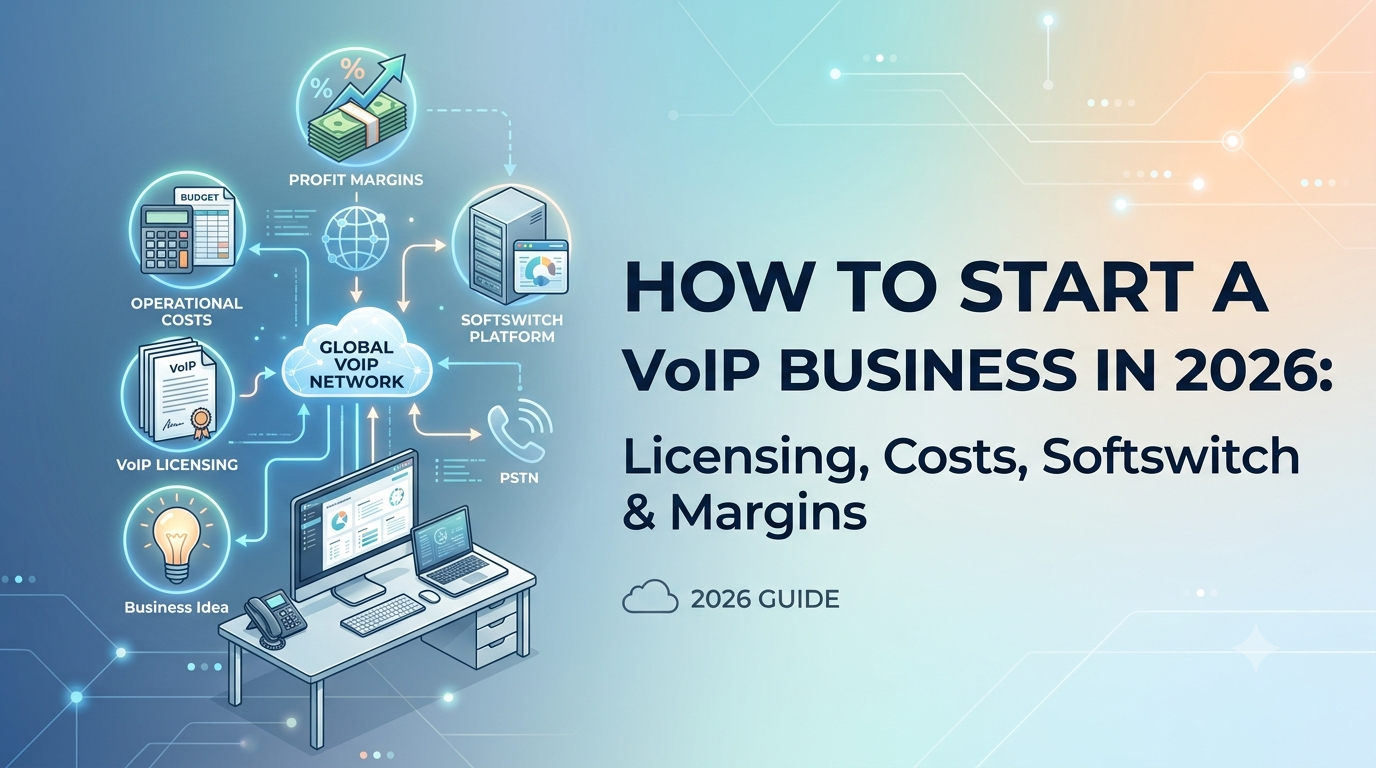
Key Takeaways
-
- Three business models exist, and they differ by capital, control, and margin: agent/referral (lowest effort, 15 to 25 percent commission), white-label reseller (50 to 70 percent margin), and facilities-based carrier (highest control and cost).
-
- Compliance is the part most founders underestimate. In the US you must register with the FCC, contribute to the Universal Service Fund, implement STIR/SHAKEN, file a robocall mitigation plan, and support E911 and 711.
-
- Margins are real but not automatic. Wholesale minutes cost fractions of a cent; the profit sits in seats, features, and support, not in raw minutes.
-
- Recurring revenue is the whole point. A VoIP business is valued on monthly recurring revenue and churn, not one-time sales.
-
- Owning the customer relationship beats reselling someone else’s brand. White-label keeps billing, branding, and retention in your hands.
-
- A niche wins. Vertical focus (dental offices, law firms, hospitality, contact centers) beats competing with national carriers on price.
Most guides on starting a VoIP business are thinly disguised sign-up pages for one platform. They skip the two things that actually decide whether you succeed: US regulatory compliance and honest margin math. This guide covers both in full, alongside the models, the tech stack, the launch sequence, and the mistakes that sink new providers.
If you are still learning the underlying technology, read our pillar guide on what SIP trunking is and how it works first, because SIP trunks are the raw material every VoIP business buys and resells. Then come back here for the business layer.
What Is a VoIP Business?
Definition: A VoIP business sells voice communication services delivered over the internet rather than traditional phone lines. It can resell another provider’s service under its own brand, operate its own switching and billing platform, or build and run carrier-grade infrastructure that terminates calls onto the public telephone network.
The market is mature, which cuts both ways. The technology is well understood and the tools are excellent, so you are not inventing anything. But you are also entering a space with established players, so your edge comes from service, specialization, and margin discipline rather than from novelty.
The businesses that thrive treat VoIP as a recurring-revenue software business that happens to involve telephony, not as a hardware sale. That mindset shapes every decision below.
The Three VoIP Business Models Compared
Before anything else, decide which model you are building. This single choice drives your capital, your compliance burden, your margin, and your timeline.
| Factor | Agent / Referral | White-Label Reseller | Facilities-Based Carrier |
|---|---|---|---|
| What you sell | Someone else’s service for commission | Your own brand on a hosted platform | Your own network and switching |
| Upfront cost | Near zero | $2,000 to $15,000 | $50,000 and up |
| Time to launch | Days | 4 to 8 weeks | 3 to 12 months |
| Gross margin | 15 to 25 percent | 50 to 70 percent | Highest, but heavy opex |
| Who owns the customer | The provider | You | You |
| Who owns billing | The provider | You | You |
| Compliance burden | Provider carries most of it | Shared, you may need FCC registration | Full, you are the carrier |
| Technical skill needed | Sales only | Moderate | Deep telecom engineering |
| Best for | Testing the market with no risk | MSPs, IT firms, consultants, agencies | Scale operators and wholesale players |
For most people reading this, the white-label reseller model is the sweet spot. You own the brand, the pricing, the billing relationship, and the customer, while a platform partner handles the switching, carrier interconnects, and much of the heavy compliance. The rest of this guide leans toward that model, with notes for the other two where they diverge.
Is Starting a VoIP Business Profitable?
Yes, and the numbers are unusually good for a services business, but only if you understand where the profit actually comes from. New founders fixate on per-minute rates, which are almost irrelevant. The money is in monthly recurring seats and value-added features.
Here is a realistic per-seat margin model for a white-label reseller:
| Line item | Per seat / month | Notes |
|---|---|---|
| Retail price you charge | $25.00 | Typical business hosted seat |
| Wholesale platform cost | $6.00 to $9.00 | Per-seat cost from your provider |
| Numbers and minutes | $1.50 to $3.00 | DID plus usage |
| Regulatory and tax pass-through | Billed to customer | USF, 911, telecom taxes |
| Support and overhead allocation | $2.00 to $4.00 | Your time, tools, tickets |
| Gross margin | $9.00 to $15.50 | Roughly 55 to 70 percent |
Multiply that across a customer base and the recurring nature compounds. A reseller with 500 seats at a $12 average margin clears roughly $6,000 in monthly gross profit, and that revenue renews every month with low churn if support is good. Add-ons stack on top: call recording, contact center features, SMS, AI features, and analytics all carry high margins because they cost you little to deliver.
The catch is customer acquisition and churn. VoIP is sticky once installed but competitive to sell. Your business is only as healthy as your net revenue retention, so a smart small-business VoIP value proposition and strong onboarding matter more than shaving a cent off termination rates.
What Do You Need to Start a VoIP Business?
Six building blocks make up every VoIP business. A reseller rents most of them; a carrier builds them.
-
- Origination and termination. Origination brings inbound calls to your customers; termination sends outbound calls to the public network. These are your core wholesale purchases.
-
- DID number inventory. The phone numbers you assign to customers, sourced from your platform or number provider across the rate centers you serve.
-
- A switching platform. A hosted UCaaS platform (white-label) or your own softswitch and IP PBX (facilities-based) that routes calls and delivers features.
-
- Billing and provisioning. A system that rates usage, generates invoices, applies taxes, and provisions new seats without manual work.
-
- Compliance infrastructure. FCC registration, USF contribution handling, STIR/SHAKEN signing, robocall mitigation, E911, and 711 relay support.
-
- Support and onboarding. The single biggest driver of retention, and the thing customers actually pay a premium for.
If you go facilities-based, the switching layer deserves special study, because the choice between a wholesale-focused switch and a retail-focused switch shapes your entire product. Our upcoming deep dive on softswitch architecture explains the Class 4 versus Class 5 distinction that governs this decision.
How to Start a VoIP Business in 10 Steps
Step 1: Choose your model and niche
Decide between agent, white-label reseller, and facilities-based carrier, then pick a vertical. “Cloud phones for dental practices” is a business; “VoIP for everyone” is a losing price war against the largest VoIP companies in the USA. A niche lets you tailor features, speak the customer’s language, and command better margins.
Step 2: Write a lean business plan and pricing model
Model your unit economics per seat, your target customer count for month 12, your customer acquisition cost, and your churn assumption. Price on value and bundles, not on undercutting minutes. Build in the regulatory pass-through so taxes never eat your margin.
Step 3: Register the business and handle FCC compliance
Form your company, then address federal telecom obligations. This is the step most guides gloss over, and it is covered in detail in the compliance section below. Do not sell a single seat before you understand your registration and contribution duties.
Step 4: Choose a platform or softswitch partner
For white-label, evaluate hosted UCaaS platforms on uptime SLA, feature depth, billing integration, porting speed, STIR/SHAKEN handling, and API access. For facilities-based, choose a softswitch and session border controller architecture sized for your projected concurrency.
Step 5: Secure origination, termination, and numbers
Contract wholesale carriers for inbound and outbound routing and a DID provider for numbers in your target markets. Favor direct interconnects and redundant routes; quality problems here surface as customer complaints you cannot easily fix.
Step 6: Set up billing, provisioning, and taxes
Implement automated billing that rates usage, applies telecom taxes correctly by jurisdiction, and provisions seats without human touch. Telecom tax is genuinely complex; use a specialized tax engine or a platform that handles it, because getting it wrong is expensive.
Step 7: Brand, package, and build your storefront
Create two or three clear packages rather than an overwhelming menu. White-label your portal, apps, and invoices. A simple site with transparent pricing and a demo booking flow outperforms a feature-dump every time.
Step 8: Test everything before you sell
Run end-to-end tests: inbound and outbound calling, caller ID and STIR/SHAKEN attestation, number porting, E911 with a live test call, voicemail, call recording, and failover. Validate call quality during peak simulated load. Use one of the best business softphones in your test kit so you can demo instantly on any device.
Step 9: Onboard your first customers deliberately
Your first ten customers are your reference base and your quality-control lab. Port their numbers carefully, follow the same disciplined cutover sequence described in our VoIP setup and installation guide, and over-invest in their onboarding. Happy early customers become case studies and referrals.
Step 10: Scale with retention, add-ons, and referrals
Once the core works, growth comes from three levers: reducing churn through great support and teaching customers to use their VoIP system more effectively, expanding revenue per account with add-ons, and lowering acquisition cost through referrals and vertical reputation. Track monthly recurring revenue and net revenue retention above all other metrics.
VoIP Business Compliance and Licensing in the USA
There is no single “VoIP license” in the United States, but interconnected VoIP providers carry real federal obligations enforced by the FCC. Ignoring them risks fines and having your traffic blocked by upstream carriers. This is the section that separates a durable business from a shutdown-in-year-one one.
| Obligation | What it means | Who it applies to |
|---|---|---|
| FCC Form 499-A and Filer ID | Register your company and report revenue; ties you into the USF system | Interconnected VoIP providers |
| Universal Service Fund contributions | Pay a percentage of interstate and international revenue into the USF | Contributors above the de minimis threshold |
| STIR/SHAKEN | Sign outbound calls with caller ID attestation to fight spoofing | Voice service providers |
| Robocall Mitigation Database filing | File a robocall mitigation plan; downstream carriers may block unfiled providers | All voice service providers |
| E911 | Deliver dispatchable location with 911 calls under RAY BAUM’s Act and Kari’s Law | Interconnected VoIP providers |
| 711 relay | Support telecommunications relay service dialing for hearing and speech impaired users | Interconnected VoIP providers |
| CPNI rules | Protect customer proprietary network information and file annual certification | Telecom and interconnected VoIP |
| Local Number Portability | Allow customers to port numbers in and out | Interconnected VoIP providers |
| State registration | Some states require separate registration and fees for number authorization | Varies by state |
The practical upside of the white-label model is that a good platform partner shoulders much of this. Many resellers operate under their provider’s certifications and STIR/SHAKEN signing, which is one of the strongest reasons to start as a reseller rather than a carrier. Always confirm in writing exactly which obligations your partner covers and which remain yours. And because this area changes, treat the FCC’s own guidance as the source of truth and consider a telecom attorney for anything ambiguous.
Compliance is also a selling point. Businesses evaluating a provider increasingly ask about caller ID authentication and reliability, themes we cover in our guide to the key factors when choosing a VoIP provider, so being able to answer confidently wins deals.
Choosing Your VoIP Platform or Softswitch Partner
Your platform partner is the most consequential vendor decision you will make, because switching later is painful. Evaluate candidates on these criteria rather than on headline price:
-
- Uptime and redundancy. Look for a documented SLA near 99.999 percent and geographically diverse points of presence.
-
- True white-label depth. Your brand on the portal, mobile and desktop apps, invoices, and email notifications, not just a logo swap.
-
- Integrated billing and tax. Native rating, invoicing, and telecom tax handling save you from bolting on fragile systems.
-
- Porting speed and number coverage in the rate centers your niche needs.
-
- STIR/SHAKEN and compliance coverage. Confirm which filings and signing they handle on your behalf.
-
- API and automation for provisioning, so growth does not mean hiring people to click buttons.
-
- Feature roadmap, especially contact center and AI voice capabilities, so you can grow revenue per account.
-
- Support quality and partner enablement, including training and go-to-market help.
For context on where the market is heading, our enterprise guide on how AI is transforming VoIP is worth reading before you lock in a platform, because AI features are becoming a competitive requirement rather than a bonus.
How to Price and Package Your VoIP Service
Pricing is where new providers leave the most money on the table. Two principles keep you profitable.
First, sell outcomes and bundles, not minutes. A dental office does not want “unlimited minutes”; it wants missed calls turned into booked appointments. Package around that.
Second, use good-better-best tiering so most customers self-select the middle. Here is a simple, defensible structure:
| Tier | Target price / seat | Includes | Positioning |
|---|---|---|---|
| Essential | $18 to $22 | Calling, voicemail, mobile app, basic IVR | Price-sensitive micro-businesses |
| Professional | $26 to $34 | Adds call recording, analytics, CRM integration, SMS | The tier most customers pick |
| Contact Center / AI | $45 and up | Adds queues, wallboards, and AI voice features | High-volume and support-heavy teams |
Benchmark your feature set against the leading unified communication providers so your packages feel complete. Add-ons are your margin engine. Extra DIDs, toll-free numbers, mobile plans paired with MVNO offerings, international bundles, additional call recording storage, and AI features all carry high margins. The contact center and AI tier in particular is where the market is growing fastest, which brings us to the biggest opportunity of 2026.
The AI Voice Opportunity for New VoIP Businesses
If you are starting a VoIP business today, AI voice is the single strongest differentiator available to you, and it is one national incumbents are slow to tailor by vertical. A conversational AI agent that answers calls, books appointments, and qualifies leads is a premium product you can attach to your core seats.
The technical foundation is the same trunking architecture you already sell, so AI voice slots naturally into your stack. To understand the build-versus-buy landscape, study our reviews of the best AI voicebot custom development companies and the leading AI voicebot companies for 2026. Offering AI voice lets a small reseller compete on capability rather than price, and it lifts average revenue per account significantly.
Pros and Cons of Starting a VoIP Business
Advantages
-
- High, recurring margins of 50 to 70 percent on the reseller model.
-
- Low startup cost for white-label, with no network to build.
-
- Sticky customers. Phone systems rarely churn once installed and ported.
-
- Scalable because the platform absorbs the technical load as you grow.
-
- An enterprise-value asset. Recurring revenue businesses sell for healthy multiples.
-
- Room to differentiate with verticals, service, and AI features.
Disadvantages
-
- Real compliance overhead, especially FCC registration, USF, and STIR/SHAKEN.
-
- Competitive sales cycle against well-known national brands.
-
- You own support quality, and one bad outage can trigger churn.
-
- Telecom tax complexity that punishes sloppy billing.
-
- Thin per-minute economics, so you must sell value, not price.
Common Mistakes New VoIP Businesses Make
| Mistake | Why it hurts | Do this instead |
|---|---|---|
| Competing on price | Races margin to zero against giants | Niche down and sell outcomes |
| Ignoring compliance until later | Fines and blocked traffic | Handle FCC and STIR/SHAKEN before selling |
| Underpricing support | Support becomes a cost sink | Build support cost into every seat |
| Choosing a platform on price alone | Migration later is brutal | Weight uptime, white-label depth, and API |
| Mishandling telecom taxes | Silent margin erosion and liability | Use a tax engine or a platform that handles it |
| No niche or brand | Blends into a crowded market | Own a vertical and a clear promise |
| Skipping E911 testing | Safety and legal exposure | Test live 911 with every deployment |
Who Should Start a VoIP Business?
The model rewards specific backgrounds. It is a strong fit if you are an MSP or IT services firm adding recurring revenue to existing client relationships, a telecom or sales professional with a book of business, an agency serving a clear vertical, or an entrepreneur willing to specialize and out-service the incumbents. Existing MSPs have the biggest built-in advantage because they already own trusted relationships and can attach voice to what they sell today.
It is a weaker fit if you want passive income with no support role, if you plan to compete purely on being cheaper, or if you are unwilling to engage with the compliance layer. VoIP is a real business, not a set-and-forget side hustle.
VoIP Business Startup Cost Summary
| Cost area | White-label reseller | Facilities-based carrier |
|---|---|---|
| Business formation and legal | $500 to $2,000 | $2,000 to $10,000 |
| Platform / softswitch | Monthly per-seat, low upfront | $20,000 and up, or hosted subscription |
| Session border controller | Usually included by platform | $0 to $15,000 |
| Carrier interconnects and numbers | Included or usage-based | Deposits and commitments |
| Compliance setup | $500 to $3,000 | $5,000 to $20,000+ |
| Branding and website | $1,000 to $5,000 | $1,000 to $5,000 |
| Working capital | A few months of runway | Substantially more |
| Typical total to launch | $2,000 to $15,000 | $50,000 and up |
Frequently Asked Questions
There is no single VoIP license, but interconnected VoIP providers must register with the FCC using Form 499-A, obtain a Filer ID, contribute to the Universal Service Fund, implement STIR/SHAKEN, and file a robocall mitigation plan. White-label resellers often operate under their platform partner’s certifications, which reduces the burden.
A white-label reseller can typically launch for $2,000 to $15,000, covering business formation, branding, a website, and compliance setup, with the platform billed monthly per seat. A facilities-based carrier that builds its own switching usually needs $50,000 or more and several months.
White-label VoIP resellers commonly run gross margins of 50 to 70 percent, and some report higher on value-added features. Profit comes from recurring per-seat revenue and add-ons like call recording, contact center, and AI voice, not from raw per-minute rates.
A reseller sells a platform partner’s service under its own brand and owns the customer and billing, while the partner handles switching and most compliance. A facilities-based carrier owns its own softswitch, interconnects, and network, giving it more control and margin but far higher cost and full regulatory responsibility.
No. Most new VoIP businesses start on a hosted white-label platform and never run their own softswitch. You only need your own Class 4 or Class 5 softswitch if you go facilities-based to control routing, features, and cost at high volume.
An agent model can start in days, a white-label reseller typically launches in 4 to 8 weeks once compliance and platform setup are complete, and a facilities-based carrier usually takes 3 to 12 months to build and certify.
Yes, in the reseller model. The platform partner handles the engineering, so your job is sales, support, pricing, and compliance coordination. A facilities-based carrier, by contrast, requires deep telecom and networking expertise.
The white-label reseller model is the best starting point for most people. It offers 50 to 70 percent margins, a low startup cost, a launch time of weeks, and full ownership of your brand and customers, while the platform partner carries the technical and much of the compliance load. Do I need a license to start a VoIP business in the USA?
How much does it cost to start a VoIP business?
How profitable is a VoIP business?
What is the difference between a VoIP reseller and a carrier?
Do I need my own softswitch to start?
How long does it take to launch a VoIP business?
Can I start a VoIP business with no technical background?
What is the best VoIP business model for beginners?
The Bottom Line
Starting a VoIP business in 2026 is one of the most accessible ways to build a high-margin, recurring-revenue company, provided you respect two truths: compliance is not optional, and profit comes from value and retention rather than cheap minutes. The white-label reseller model lets most founders launch in weeks for a few thousand dollars while owning the brand and the customer.
Pick a niche, choose a platform partner you can grow with, handle the FCC layer properly, price for value, and attach AI voice to stand out. Do that and you are building a durable asset, not chasing a trend.
Leave a Reply